Mother’s Day is a day to pay tribute to your mother, the one person who loves you more than anyone you will ever meet in your entire lifetime. You can buy your mother flowers, give her a fancy card, or treat her to dinner to show her that you appreciate all that she had done and sacrificed for you. But when your mother passes away, you can no longer do anything to show her how much you love her. When you lose your mother people will comfort you by saying, “she will always be with you.” The reality is that she is not. She is gone from your life forever. The only thing you can actually do on Mother’s Day is think of her.
My mother has been gone for almost six years now, and I think of her every single day. My mother and I were a lot alike and we had a great relationship. It is easy for me to close my eyes and think of the many times that she went out of her way to help me, to give me good advice, to make me feel loved and protected. But today I realized that one of the most precious memories I have of my mother was not from one of the good times we spent together, but from one of the worst.
As I enter the house, my mother is not buzzing around energetically wiping the kitchen counters or calling out a greeting to me as she is finishing a task on the home computer. This day my mother, or what is left of the vibrant woman she once was, is sitting up in her bed, her emaciated frame propped up on pillows. She says nothing to me as I say hello, trying my best to sound cheerful. I make small talk as I lift the covers and empty one of her drains into a small container on the floor next to her bed. I keep talking as I leave the room briefly to flush the contents down the toilet and return to her bedside to reattach the tube. All things medical use to make me queasy, but it’s been almost nine months since her first surgery. I am tougher now.
I sit on the bed as close to her as I can get. She is wearing a black and white striped mumu, her fashion of choice for hanging around the house and the source of endless teasing from my sister and I. This mumu that once fit her now looks like it is five sizes too big because she weighs barely eighty pounds. Her face looks gaunt and slightly gray. She has fought so hard, but now she is tired. I know that all hope is gone and that her death is imminent. This could be the last time I see her alive, but I cannot say goodbye. She is still here.
I run out of things to say, so we just look at each other for a few moments. Then my mother raises her arm slowly and touches my face with her fingers. She smiles and says softly, almost in a whisper, “I am proud of myself.” It was difficult for her to speak. I don’t know what she means so I lean a little closer and ask her why. Still stroking my chin she says, “Because I raised you.”
In these days before her death, I assume that my mother was reflecting back on her life, feeling good about everything she was able to accomplish and regretting the things that she had to leave unfinished. The knowledge that my mother considered me one of her life’s greatest successes makes me feel deeply loved. Her soft words spoken in the worst of circumstances inspire me to be my best self so I can always be the woman who makes her so proud. I love her so much. On Mother’s Day (and many other days) it warms my heart to think of this special moment we shared. Thank you Mom.
Happy Mother’s Day!
Sunday, May 12, 2019

Saturday, November 22, 2014
Why I Go to Church
Whenever
I am asked what my plans are for any given Sunday, I always begin with the
phrase, "after mass." I attend
church religiously, no pun intended, every Sunday morning at 8:00 am with my
two children in tow. It does not matter
if I am tired because I was up late socializing with friends on the previous
night. It does not matter if I am
pressed for time because I have to go food shopping or get ready to attend an early
afternoon function. It does not matter if
I need to complete the household chores that have piled up during the hectic
week, or even if I am feeling slightly under the weather. I do not go to church on a regular basis to
avoid a sense of guilt of to fulfill an obligation ingrained in me by my Catholic
parents. I go to church because it is
good for me. I go to church because I
like it.
I did
not always felt this way of course. When
I was growing up my parents took me and my siblings to church every week,
either on a Saturday night or Sunday
morning. Our church was located on the
top of a tall hill with about a million narrow and steep stone steps to climb. By
the time we crossed the threshold of the church, our thighs were sore! The priests were old and their sermons were
long and boring (to a child like me with limited understanding and a short
attention span). The average mass lasted at least one hour and
it was difficult to sit still. Although the effort of my parish's choir was valiant, the music was shrill and off-
key. The children's choir was especially
loud and often accompanied by an interesting array of instruments, such as the
tambourine, that were not quite fitting for the atmosphere. Even today my sister and I still joke about
its use in the choir's Broadway-like rendition of the "Hallelujah."
When my sister and I tried to play the "I
feel too sick to go to church" card, my mother would always respond by saying,
"Well, if you are too sick to go to church than you need to stay home and
lie down for the rest of the day."
Realizing that this outcome would mean a day without any fun activities,
we were magically cured and found ourselves making the long climb up the stone
stairs to attend mass. We were enrolled in weekly religious education classes,
attended the required retreats, got ashes and palms, had our throats blessed,
and made our sacraments. At the end of
my adolescence, the routine of going to church was thoroughly ingrained in me.
I dutifully attended mass weekly throughout
college and into adulthood. My devotion
to my religion was strong, but largely
based on a sense of obligation. My first
words to my non-Catholic boyfriend after I accepted his marriage proposal were,
" as long as we get married in the Church and raise our kids as
Catholics." As the years passed and
I became an adult, my life experiences began to change me, change my
relationship with God, and change my motivation for attending mass. Now that I am older I recognize the personal
benefits of going to church and can appreciate the central role my religion
plays in my life. I no longer feel that
I "have" to go to church. I
feel that I "want" to go because church is the place where I find
wisdom, peace, love, and inspiration.
The
readings from the Bible and the gospels offer solid advice about how to live a
Christian life. These truths may be
obviously stated in clear language or they may be embedded in awkwardly worded phrases
or even hidden in cryptic parables.
However, if I pay close attention to the readings and the sermon, I can
always relate the advice from biblical times or the teachings of Jesus to an actual
problem or situation in my personal or
professional life. It might be a new way
to approach a problem or a positive attribute to which I should aspire, but I
always am enlightened and inspired in some way.
Each week I leave mass a little smarter than when I arrived. Each week I leave mass with a goal to
strengthen my character. Attending mass
is the ultimate self-improvement seminar!
In
church I have experienced the spectrum of emotions that make me human, often at
the deepest of levels. On my wedding day I felt soaring joy and hope for my
undetermined future coupled with the weight of the serious commitment I was making
to my husband and to God. My heart was full of gratitude as I witnessed
my children's foreheads being washed clean on their baptism days. When my autistic son was a toddler and life at
home was hectic and hard, attending mass was my refuge. It was the only time all week that I had the
opportunity to be still, to think, to relax.
I was excited and proud to see my children make their first communions. At my mother's funeral I felt profound
sadness, sobbing silently for the loss of her love. I feel renewed after going to confession and
empowered after receiving the Eucharist.
The melodies and lyrics in the music played each week at mass remind me
of these emotional moments. While some
of these memories make me feel happy and some make me feel sad, they all make
me feel loved. I feel loved by God and
by the people He has put into my life.
When I
am in church I feel comforted knowing that I am part of a family that is larger
than my own. I enjoy exchanging smiles
and shaking the hands of people that I do not know. I like the sound of our congregation praying
and singing in unison. The occasional mistakes made by the readers
and the voices that are sometimes off key have a special sound - they remind me
that although we try our best, we are all imperfect! My favorite part of the mass is when the
parishioners line up to receive Holy Communion.
Men, women, and children, of all ages and sizes line up with their hands
outreached to receive Jesus Christ. I understand
that although we look very different from each other on the outside, we are
essentially the same on the inside. We
are gathered together in church like we are gathered together in life, created
by God to love each other as He loves each and every one of us.
Being in
church reinforces the truths about life that I already know but often overlook:
that I am loved by God and have been blessed by Him in countless ways; that I
am not in charge of what happens in life, He is; that one day I will live
forever in heaven with Jesus and everyone that I love. Participating in the rituals and routines of
the mass each week gives me a tangible way to experience the intangible
concepts of my religion. Going to church
reminds me of why I am here and what I need to do. Each
Sunday as my children and I walk toward the altar to sit in my family's front
pew, I look upward at the hanging crucifix and hope that my example will
instill in them what my parents' actions instilled in me. I pray that someday when they are older they
too will realize that going to church is not only is good for God. Going to church is good for them too.
Monday, October 13, 2014
Bowling Alley Coffee

On the weekends I have time, an elusive
commodity that I lack during my work
week. I have the time to make a full
breakfast for my children and the time to watch them eat it. Although my dog wakes me up at 5:00 am as
usual, I can go back to bed and get up "late" (which is 7:30 in my
world). I can go for a quick mid-morning run or a
longer one in the late afternoon. I can spend my time only with the people of my choice, especially my husband
and my two sons. I would assume that my list of weekend pleasures is fairly common,
except for one rather unusual item- bowling alley coffee.
There-
I have admitted it. I enjoy bowling
alley coffee and look forward to ordering a cup of it each week. I realized this peculiar attachment last
weekend. My son had barely thrown his
first warm-up ball and I was already at the counter, waiting with my eighty
five cents. The coffee is served in a
white Styrofoam cup and is filled to the top,
leaving little to no room for cream.
I am not daunted by this challenge as I take my coffee to the opposite
counter, lay a napkin on the surface,
and get ready to customize my treat.
I add several packages of "cream" (or whatever that white
liquid is) and even more packages of sugar.
I slowly stir it all together and then I gingerly carry my
filled-to-the-brim beverage to my sons' lane.
I settle into my chair, watch him bowl, and take my first sip. Ahhhhh.....I am indulging in a true weekend
pleasure.
Now
here comes the peculiar part of my story.
The coffee does not taste good. In
fact, it actually tastes quite bad. It
has always been, well, rather horrible. No amount of "cream" or sugar can change the bitter flavor. Other parents arrive with cups of delicious
coffee from Dunkin' Donuts or McDonalds.
But I buy coffee at the bowling alley every week and I drink every drop
and as I stated earlier, I look forward to doing so. So why do I enjoy drinking my cup of bowling
alley coffee?
Routines
are patterns of behavior that do not change, and thus provide comfort. Drinking the bowling alley coffee is part of
my weekend routine. During the hectic
and unpredictable weekdays when I often feel rushed and anxious, at least I know that when the weekend arrives
on Saturday morning I will be able to buy my coffee, fix my coffee, and drink
my coffee at the same time and in the same manner as I did the previous
week. When I am doing so, I will be
watching my son participate in an activity that he truly enjoys and in which he
truly excels. Nobody will be asking me
to do anything at that moment. I cannot
leave until he bowls his strings. I have
no task to complete or chore to finish.
All I can do is sit and watch, and sip.
Wednesday, August 20, 2014
Riding the Wave
I made
the most of my summer vacation! I slept late nearly every day, lounged in the
sun at the beach and by the pool, stayed up late watching television, and got
an awesome tan. I lost track of what day
of the week it was and thought about no children other than my own. When I
think about going back to school next week, I have a vision of myself standing
on a beach with a mammoth wave swelling behind me, above my head, waiting to crash upon me on
teacher orientation day. The last few days of summer vacation are truly the calm
before the storm. They provide the
perfect time for reflection about the relaxing time that soon will be
behind me, and anticipation of the
stressful days that lie ahead.
When you
are a teacher, the beginning of the school year is a time to reinvent
yourself. You are a stranger to the
students sitting in front of you. They
have never been in your classroom before and they do not know what to
expect. Everything from the daily
routines to the tone of the environment has to be established by you. If you were unhappy with what you did in the
previous school year, you can change it now.
You have a clean slate and with that opportunity comes a feeling of
power. Remember how exciting it feels to
open up a brand new notebook and see the first blank page? Once you actually write on the paper you cannot
return to the special time before you did so, when you were just planning and
dreaming about how you wanted the page to look.
This is how we teachers feel at
the beginning of the school year. We
have a the chance to make a fresh start.
Each
September gives you can create new goals to achieve without feeling the guilt
of failing at those same goals in the past.
Although the last school year was less than three months ago, to a
teacher it feels like a lifetime ago and can barely be remembered. At
the beginning of each school year I set the same goal: to keep the pressures of
the job at bay and retain a lasting positive attitude. I aspire to hold off the wave in my vision,
the powerful influx of demands and tasks that have overtaken education and
changed the fabric of my job to the point of making it unrecognizable. Wow- I can feel my heart beating faster and my
stress level rising even as I type these descriptive words.
When I
started teaching in 1993 my primary responsibility was to teach. My
job required me to deliver information to the students in my content area of Social
Studies. Back then, most of the students
knew how to read and write and completed their assignments. Even if they did not like it, back then most students
recognized the importance of education and the authority of the teacher. There
was respect for the professionalism and wisdom of teachers. Parents and administrators were supportive. Creativity was encouraged and learning could
be fun and productive. The daily schedule
included small breaks, allowing students and teachers valuable time to breathe,
to communicate, to make personal connections.
It was during one of these nonacademic moments, a former student told
me, that I made a comment to her that literally changed her life's direction.
But as
the expression goes, "that was then and this is now." Ask any educator or student, things are
different today. Schools are run like
businesses and the profit margins are high
test scores. The pace is exhausting and
the demands are unreasonable for all involved.
Gone is the creative freedom that was my forte. Gone are the moments to inspire lives. Gone is the focus on growing the talents and
strengths of each and every student. We
concentrate on numbers, cohorts, and spreadsheets now. We have data meetings and spend hours and
hours staring at numbers of all kinds. This
is the new wave in education, the wave that I am bracing for next week.
In many
ways I am ready to return to work. I
find comfort in the organization of my family's fall routine. My mind gets restless by the beginning of
August and I crave the intellectual challenges inherent in teaching. In my heart, I will always feel that teaching
is the most noble profession and I am proud that I am an educator. But as I prepare my classroom for a new group
of students, I will also be preparing myself mentally for the pressure and
stress that lie ahead. I am once again
setting my annual goal to remain positive as I go to work each day in an
environment that no longer makes sense to me.
I am hoping that when the gigantic wave crashes down on my next week, I
can ride it.
Tuesday, August 19, 2014
Saying a Final Goodbye
Last June my aunt died of a sudden heart attack. Three weeks later my mother succumbed to a
year-long battle with colon cancer. Enduring the trauma of these two losses reinforced
my understanding of a grim reality of life.
It does not matter if the end of
a loved one's life comes quickly or slowly, whether you know it is going to
happen or are taken by surprise, whether you are blindsided or are prepared. No matter what the circumstances may be, no
one has the luxury of saying a final goodbye.
My
godmother and aunt Tessie was truly a second mother to me. I spent a lot of time with her and my uncle
when I was growing up and I have countless happy memories of our times
together. As I grew older, got a job and had a family of my own, I had fewer
opportunities to spend time with my aunt. When she died, I had not spoken to her in a
few months, but I believe that she knew how much I loved and adored her.
Our last
conversation was a text message exchange on her birthday in March. I have saved this message on my telephone and
look at it from time to time. I began by
wishing her a happy birthday and she
thanked me, joking about how old she was.
I texted back, "You may be
older but you are looking damn good! I
have a great day! I love you!" The
last words I communicated to my aunt were the ones I would have spoken to her
if I was there the night she unexpectedly passed away. I loved her and I told her when I had the
chance, and that brings me peace.
I had
plenty of opportunities to have a final goodbye conversation with my
mother. I was with her in the hospital
room when the doctors delivered the news that she would not survive. I was with her at home during the nine days
she spent there before moving to a hospice center. I was by her bedside when she lost
consciousness and left only hours before she took her final breath. But I never said goodbye.
I could not say those words because I did not know exactly when she was
going to die. It never seemed like the
right thing to do. If I said those words,
I was giving voice to the finality of her death, making it a reality. I did not want her to die, so I did not say
goodbye.
But I
didn't really have to because of a special moment my mother and I shared before
she went to hospice. She was sitting up
in her bed when I came to see her. At
this stage in her illness she weighed less than ninety pounds and was extremely
weak, barely able to move or speak audibly.
I emptied her drainage bags, cleaned her bedding, and helped her change
into a clean nightgown. I was sitting on
the edge of her bed, looking into her eyes, speaking no words. She was looked at me, raised her hand, and
gently stroked my face. She said,
"I am proud of myself." It
seemed like such an odd comment I
questioned, "Why are you proud of yourself?" Her eyes filled with tears and she said,
"Because I raised you." I had
no words. In this
brief conversation my mother expressed her feelings toward me. My constant presence by her side in her most
difficult moments expressed mine. The
love we had for each other was evident.
There was need to actually say
"goodbye."
I do not choose to use the phrase "learning a life lesson" to describe my painful experiences last summer. The word "learning" implies that you previously did not know something, but I already understood the importance of treasuring and appreciating my loved ones. I already knew that we need to tell our family members and friends how much we care for them while they are still here with us. I already knew that our actions can show the depth of our affections more powerfully than words. I already know how lucky I was to be loved by two of the most precious people who ever lived. My losses showed me that circumstances can sometimes render words insufficient or impossible. I was reminded that you cannot wait for the chance to express your feelings for someone you love in a tidy, final conversation. That chance might never come or may come in a form that you do not recognize or expect. Sometimes, perhaps often, things don't end with a "goodbye." They just end.
I do not choose to use the phrase "learning a life lesson" to describe my painful experiences last summer. The word "learning" implies that you previously did not know something, but I already understood the importance of treasuring and appreciating my loved ones. I already knew that we need to tell our family members and friends how much we care for them while they are still here with us. I already knew that our actions can show the depth of our affections more powerfully than words. I already know how lucky I was to be loved by two of the most precious people who ever lived. My losses showed me that circumstances can sometimes render words insufficient or impossible. I was reminded that you cannot wait for the chance to express your feelings for someone you love in a tidy, final conversation. That chance might never come or may come in a form that you do not recognize or expect. Sometimes, perhaps often, things don't end with a "goodbye." They just end.
Monday, August 18, 2014
Five Hundred Words
I usually do
not participate in the many group challenges and activities on social
media. I do not play Farmville on Facebook and I get
annoyed when someone gives me a life on Candy Crush. I immediately delete any "chain
letter" like requests for me to forward a message to nine of my friends or like a post within
thirty seconds of viewing it. I have not
filmed myself dumping a bucket of ice
water on my head for charity. But yesterday I made an exception to my
self-imposed boycott. I accepted an
online challenge to write at least five hundred words a day for thirty one
days.
I have always enjoyed writing and
have dreamed of being an author since I was in middle school. In high
school I recall sitting in English class when the teacher announced a
writing contest on the topic of literacy.
I remember thinking, "I am going to write an essay and I am going
to win." Well, I did what I set out
to do, I wrote the essay and I did win.
I received a certificate in a leather folder at the Biltmore Hotel. I continued to find success throughout high
school and college writing papers and earning high marks
When I was in college at the
University of Rhode Island I took a course about the Civil War. My professor was tough, announcing on the first day of
class that, "I don't give A's."
Feeling confident to prove him wrong, I wrote an essay on the short
novel A Man Without A Country. On the day he returned the corrected essays
to the students he asked to speak to me after class. He was impressed with my writing and I felt
successful. I worked on a few projects
for him during my college career, including one in which I researched and wrote
a description of a historic department store in South Kingstown, Rhode
Island. I still have my manuscript,
produced an a typewriter on onion skin paper with red margins.
My writing repertoire expanded as I took
graduate courses. I wrote papers for my
own courses and a few for my friends and boyfriends as well! While writing papers seemed difficult for
others, it was easy for me and I enjoyed it.
When I got my job as a middle school
Social Studies teacher, my writing projects changed. I no longer wrote research papers, of course,
but I did re-write articles to make them easier for my students to
understand. Teaching the elements of
writing became part of my job description.
I became skilled at writing recommendations for students, capturing
their strengths in a way that produced compliments from my colleagues who read
and signed the letter.
At the end of the last school year
my grade leader announced that she was moving on to another position at another
school. She did not want to leave, but
circumstances and contractual rules left her no choice. All of the teachers in our grade were
disappointed and wanted to do something to show our support. Someone suggested that we write her a letter
of recommendation, and I quickly volunteered.
When I was finished writing the document, I passed in along to all
fifteen of my colleagues for their signatures.
As they read the letter they nodded with approval, commenting how my
words expressed their feelings.
It was after this experience that I
decided to begin writing. I have a
talent and an ability that I need to explore, refine, and improve. Writing is not easy. It requires time, energy, and concentration, all precious commodities of
which I have little in the course of my busy life. But I realize that if I am ever going to
write that book that I have always dreamed of writing, I need to start. I could not just read about the five hundred word challenge
online. This time, I had to take it.
Sunday, August 17, 2014
I Am Okay, Mom! I Am Okay!
While there are no marathons in my future, I certainly do
enjoy running and have made it a part of my weekly routine for the last seven
years. I love to run because I choose to do it by
myself. I am alone. There is no one to talk to, no questions to answer, no requests from my
children, no demands from my co-workers or students. It is just me, the pavement beneath my
sneakers, and the inspirational tunes playing from my IPod. There is nothing to do but run and think
about, well, anything that comes to my
mind.
I run and plan what I am going to do later that
day or the next. I run and dream about
what I want to achieve in life, about the type of person I aspire to
become. I run and think about topics both meaningful and trivial. I run and problem
solve situations both real and anticipated.
I even count my footfalls per minute.
But my favorite mental activity to do when I run is to remember. I outwardly smile as I think about funny things
from my past. Such memories are often
triggered by the songs I listen to, especially
if I am listening to my eighties playlist.
It is relaxing and refreshing to lose yourself for a few moments and let
your mind lead you to wherever it decides it wants to go. All you have to do is follow its path.
Once a
week I like to push my limits as a runner and run for an extended distance. My usual route is about three and a half miles
and my long route is about five and a half
miles. I choose Sundays to make this
long run because it takes me about fifty minutes to complete and I can find more
time on Sundays to devote to myself and do something that I enjoy doing than
any other day in the week. I look forward to spending this time alone and
enjoying the mental benefits I have come to treasure. On my long run I always experience the same
memory as I approach the same part of my route.
Although I have had this same memory every time I have run this route
over the last year, it was not until today that I appreciated its meaning.
I am
running on the side of a well-traveled road that ends at an intersection with a
stoplight to manage the traffic. It is a
hot summer day, the kind of day when people warn you to avoid exercise. As I approach the intersection, I take a left
onto another busy road. I stay on the
sidewalks and although there are a lot of cars traveling in both directions, I
am safe. Once at this spot, just after I
had made my left hand turn, I saw my mother driving by. She was traveling away from the directions in
which I was running, in the opposite lane heading toward the traffic
light. She saw me and instinctively
slowed down. She rolled down her window
, looked my way, and was trying to get my attention. She was obviously looking to see if I was
alright. She was holding up traffic as
she was calling out to me. I could sense the impatience of the annoyed drivers
behind her. I waved my arm over my head
in a large motion directing her to pass by, calling out, "I am okay,
Mom. I am okay!" She drove away when she heard me and,
thankfully, there were no collisions.
I have this
memory every time I pass this location on my long run. At
first after my mother passed away, it was a painful memory. I ran by and choked back tears. Nobody but your own mother would stop a car
in the middle of traffic just to see if you were okay! My mother was gone and so was that unique
love. I felt badly for myself. But as time passed, and I kept running by
this location, the memory has lost its
sadness and has taken on a different, peaceful feeling. It reminds
me of how blessed I have been because when my mother was alive, she was always
looking out for me. She devoted her life
and did everything she did so that I would be okay. Being a mother myself I realize that our goal in life is to prepare our children to live without us. My mother accomplished this goal with grace
and beauty. She was an amazing person
and I was so lucky to have been loved by her.
I
deeply miss my mother, but when my mind's eye sees her slowing down traffic in
her Toyota Camry, looking my way and calling out to me, I cannot help but smile.
I enjoy remembering that brief yet meaningful
moment. Today as I ran by the spot, I thankfully
waved my arm in the air and called out,
"I am okay, Mom. I am okay!" Even though she was not there, I know she
heard me.
Saturday, August 9, 2014
Accidental Advice: How Five Simple Phrases Have Changed My Life
Sometimes the most enduring pieces of advice can be delivered by the most unlikely of people at the most unexpected times. There are days that I forget my most needed grocery item or why I walked into a particular room, but I easily remember a handful of treasured statements spoken to me over the years. These phrases were delivered casually, mostly by people who did not intend to impart lasting wisdom. But for some reason, these words resonated with me and have found a special place in my heart. These phrases frequently pop into my head often as I experience the happenings of daily life, either to inspire me or to reinforce a simple truth. While I have gleaned different meanings and messages from these pieces of advice at different times in my life, the wisdom embedded in these phrases is truly timeless.
1. "It's not you I don't trust, it's the other guy."
Spoken by my anxious father when I was learning how to drive, this phrase always accompanied a denial to my request to borrow the family car. As an innocent teenager, I could not relate to these seemingly unfounded concerns. Nothing bad was going to happen to me so why were my parents always so worried? Now that I am a parent, I can answer this question easily! Adults see the world very differently than children. Growing up means that you know about the parts of life your parents shielded you from when you were younger. Having a child makes you feel vulnerable. These words make me appreciate how deeply my parents loved me. My youngest son is turning twelve this year and wants to be more independent. I will be thinking of this phrase often as he begins to ask me for more freedom.
2. "Everything is two trips."
I think of this truth every time I get home from the store only to realize that I have to go back to fix a problem. Maybe the cashier overcharged me for an item or I forgot to buy something I needed. Perhaps I bought the wrong size or a piece of the product was missing from the box. Whatever the reason, rarely can you succeed at an errand, or anything, in just one take. This phrase, spoken by my beloved godmother and aunt Tessie, makes me chuckle at the never ending frustrations of life. There will always be some wrench in the plans, some fly in the ointment, some complication with which to deal. I smile broadly when I think of Auntie Tessie, her love, and her many words of wisdom. Before spring break one college year, she wrote a list for my sister titled, "Tessie's Tips for Safe Trips." Number one on the list was "Don't go."
3. "If it's not behind you, you won't hit it."
This statement seems obvious and kind of silly, I know, but for me it serves as a healthy reminder to relax. Several years ago, I became friendly with a young woman who worked as a community support worker for my son. We bonded instantly because we shared similar personality traits, including a tendency to over-think, over-analyze, and worry about a wide variety of situations, most of which had not and probably never would happen. One day we were arriving home after an outing and we were pulling into my driveway. When she questioned my as to why I was not backing the car in, I told her that I was too nervous to do so. I admitted that I never learned to use the car mirrors to maneuver into parking spaces or to make judgments about what direction my car was turning. I was afraid to hit something behind me. So at the ripe old age of thirty-seven, she began to teach me how to back up my car using the mirrors, reassuring me by saying, "If's it's not behind you, you won't hit it." I hear these words just about every time I shift my car in reverse, even though I now have a back-up camera to help me. But over the years I have broadened the meaning of this phrase. I now think of this advice when I need to be calm, when I need to stop worrying about something that does not exist.
4. "Your son is so teachable."
When my son Tommy started school, I completely overwhelmed by his diagnosis of autism. He could not communicate with words, had frequent tantrums, was unable to focus his attention, and suffered physical discomfort from a sensory integration disorder. I remember feeling a sense of horror when I put him on the school bus the day after his third birthday to attend a public preschool special education class. What was going to happen to my son without my presence by his side? What was he going to be able to learn, now, or ever? Thank goodness he had an understanding teacher, who communicated with me via journal on a daily basis. Sensing my worries, one day she shared with me the name and telephone number of a parent whose son was in Tommy's class. Her name was Roberta. Her son was six and getting ready to move out of the preschool level. I was reluctant to call and ask for help and advice, and stared at the number in the communication book for a few weeks. I remember being teary-eyed when I finally reached out and made the call. The woman on the other end was cheerful and positive, two qualities I didn't realize the mother of an autistic child could possess. She told me she had been volunteering in the classroom and had observed Tommy. Roberta told me, "your son is so teachable." Teachable? Teachable? Hearing that word felt like being thrown a life jacket on the open ocean. Hearing that word rescued me. As Tommy's mother, I believe I knew it was true inside my heart, but I needed to hear it. I needed to hear someone else, a stranger, a neutral party, tell me. Hearing that world changed my world. It helped me adopt a positive mindset in all aspects of Tommy's development, at home and at school. Tommy will always need to learn, but he will. Tommy is teachable. Thanks Roberta!
5. "Worry about the things you cannot replace."
I felt like a queen living in a palace when I bought my house. I remember standing in the kitchen, looking down the hallway, and marveling at its length. Compared to my apartment, this two-bedroom ranch with a front and back yard was expansive! My husband and I were focused on keeping the property looking great, and we took great care remodeling the inside and landscaping the outside. Although I had been a teacher for several years at this point in my life, I was not yet a mother. After I arrived home from work I wanted peace and quiet. So I would quickly get annoyed when my neighbor's sons and their friends would run up and down the street, throwing balls, and making noise. I particularly disliked the instances when these children ran through my front yard and threw balls that loudly struck the fence. One day I came home from work to find three kids standing in the middle of my lawn, hanging around my lamp post. I went into full teacher-mode and sent them away with a stern lecture. I am not sure how it happened, but later that evening my neighbor's from across the street were in my driveway talking to my husband and me. I shared my story about the trespassing kids, their disrespectful and rude behavior, and how much it bothered me. At some point in the conversation my neighbor Cynthia told me to, "worry about the things you cannot replace." The comment meant nothing to me at the time. Later I realized that when she spoke those words to me her mother had recently passed away. I think of her words often, especially now that I have lost my own mother. Her words remind me to focus on what is important in life- people.
Wednesday, July 9, 2014
The Final "First"
Tomorrow marks the one year anniversary of my mother's death, and I am anxious to have the day come and go. Over the last year I have been constantly remembering the "last" moments of our relationship. These memories are numerous and are triggered frequently. A seemingly insignificant action or word can now evoke a powerful emotion because it unearths a memory of the "last" time we ever did this or the "last" time we ever said that. While these final memories can make me feel sadness, they can also soothe me with a sense of gratitude and peace. I am deeply appreciative that I was given such a beautiful person to be my mother and I know she now lives in the paradise of heaven.
It has been the events I classify as "firsts" that have been the most unexpected and painful to endure over this last year. The "first" time I reached for the telephone to call my mother, as was my habit at least twice a day, only to realize that I could not talk to her anymore. The "first" trip to the cemetery to lay flowers at her gravestone. The "first" family gathering without her presence. The "first" important activity or milestone achieved by one of the grandchildren not witnessed by my mother. The "first" holiday celebrated without her. The "first" time my birthday passed without hearing her voice wishing me a happy one, the most difficult "first" moment for me by far.
Over the last year the list of mournful "firsts" grew and grew with only one end in sight, and that end is finally here. Tomorrow's anniversary will not be a day when I miss her more deeply or think of her more often. As I am mothering my own children she is never far from my mind and I will never stop wishing she was here with me. Tomorrow's anniversary serves only one purpose. It is the final "first."
I remember the "last" time I spoke to my mother when she was still cognizant of my words and presence. We were in the car on a Sunday, traveling again to the emergency room, desperately seeking another miracle. I had one hand on the wheel and one arm across her chest as she slumped forward in the passenger seat, too weak to sit up straight. She said ,"I cannot open my eyes. I am just so tired," to which I responded, "It's okay, Mom. Just close your eyes and get some rest."
Wednesday, April 2, 2014
Autism Awareness Day
My son is highly functional, but because of his autism, his days are full of numerous challenges, unrecognizable to you and me, that he must overcome while still managing to look "normal" to an indifferent and judgemental world. Autism has shaped our family routines and defined the depth of the relationships that we have with each other, our extended family members, and our friends. Autism has often been the decisive factor in determining where we can and cannot go and if we can go, how we will participate. Autism creeps into our minds as we dream about what the future may hold. Autism reeks havoc on our expectations, forces us to adjust and accept, hardens our resolve, strengthens us and exhausts us. Autism is there when we go to sleep at night and is waiting for us when we rise in the morning. Autism is a force to be reckoned with, day in and day out, week after week, year after year. For families like mine, everyday is "Autism Awareness Day."
Sunday, March 16, 2014
For the Love of Belle
I will never forget that hot summer day when my husband and I traveled to the breeder's house to select what would become our first family pet. When we spotted one precocious puppy that climbed on the heads of the rest of her siblings and did a belly-flop into the water bowl, we knew we had found our yellow lab! We named her Belle, took her home, and had no idea what a tremendous impact she would have on our lives.
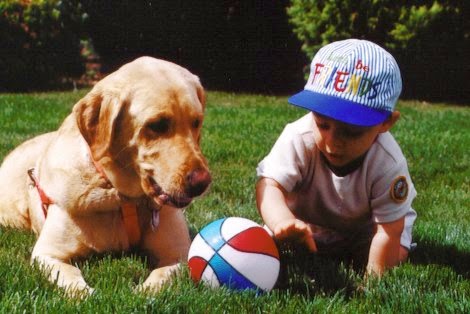
Walking Belle for at least three miles each day became part of our daily routine. She grew from an energetic, playful puppy to an energetic, playful, eighty-five pound adult. Belle possessed every well-known and beloved characteristic of a Labrador retriever. She would incessantly retrieve any object we could throw at her. She allowed admiring strangers of all ages to pet her. She jumped with joy at the sound of her food being scooped out of its bag and at the sight of anyone at, or near, our front door. She sat in front of us when we needed a hug, beside us to share in our snacking, and kept us warm at night as she lay at our feet. Belle became as treasured a part of our family as any of her human relatives.
When our son Tommy was born a few years later, Belle became a caring and protective big sister. She faithfully sat beside his highchair at mealtime catching falling pieces of food. She used her body to shield him from household dangers. She endured his far from gentle signs of affection. Belle was up with my husband and me on those sleepless nights. Whenever Tommy was upset and cried, she would always come to check to see if he was alright. Like all labs, Belle's emotions were written all over her face and in her soulful eyes. Her concern for him was evident. A definite loving bond had developed between the two. I have read stories about how loyal dogs who loved their family members so much sometimes acted heroically to save them from danger. My story is a bit different. In our case, Belle's love for Tommy saved her life, not his.
Like all labs, Belle loved to swim. When she was a puppy, we trained her to retrieve an orange float toy at the beach. Belle would sit beside us on the shore line, her full attention on the toy we held in our hand. After we threw the toy into the water as far as we could, Belle would run into the ocean on command, dashing fearlessly into the waves. She would paddle to the toy, scoop it into her mouth, pivot, and triumphantly return to shore with the prized possession. She became so well-trained that her obedient retrieving routine would attract the attention of people walking by who often stopped to watch the beauty of her swimming, the one and only activity that would truly maker her tired. In the water, Belle was in lab heaven! She would not want to stop until we dragged her from the water by her leash. Our beach routine was well-established, and we never had a problem with her behavior, not until one day in early June, 2001.
The weather was windy but clear as Belle began her day obediently retrieving her toy. Several family members came to the beach with us that day, and our son Tommy, then thirteen months-old, was sitting with them on shore. I was closer to the waterline, throwing Belle's toy into the water and she was having her usual fun bringing it back to me. For some reason on one unremarkable throw, Belle bolted rapidly into the water as usual, but she could not see where the toy was floating. Whenever this happened in the past she would turn around in the water, her head looking much like a periscope, until she located it. This time, however, she simply turned toward the horizon and began a strong, swift swim out into the open ocean. I called to her, thinking she would certainly turn around, but she did not. I ran in the icy cold water, still calling to her, but she kept swimming away. I walked to the location of the orange float, the water up to my chin, and I held the toy up high so Belle could see it, but she was not looking back.
As desperation and panic filled my heart, alarm also had arisen on shore. Belle was fast becoming a yellow dot on the horizon, swimming out past the buoys. There was no lifeguard because were were on a private stretch of beach. A family member ran to the neighboring beach for help, but the lifeguard there said he could not leave his post. Nobody had a boat and Belle was too far out for anyone to swim to help her. A crowd had gathered on shore, everybody shouting, "Belle! Belle!" I was in the water as far as I could safely swim, calling for her to no avail. The ripples of the water blocked my view and I could not longer see her. I could see only the ocean.
I remember the events of the next few minutes as if they happened in slow motion. Water was splashing in my face and I could hear the wind and the muted voices of those yelling back on shore. I then heard a screaming that I was all too familiar with, that of my son Tommy. He was in the arms of one of my distraught family members. The volume of her voice yelling for Belle and the stress of the situation had scared him so much that he became extremely upset and had begun to wail. As I turned my head to see him and make sure he was alright, I heard somebody yell, "She's coming in! She's coming in!" I turned my head back to the ocean and between the water splashing across my face I saw a yellow dot that became bigger and bigger as it came closer. It was Belle, heading right for me, heading for shore!
She paddled toward me I was ready to take her in my arms and help her. After all, she had been swimming for a while and I prayed that she would make it close enough to me before exhaustion overtook her. Much to my surprise, however, she swam to me and then past me. She was heading for shore. I chased after her, running through the water as quickly as I could, and saw her gallop out of the water and directly to Tommy's side. Other than being annoyed that I would not allow her back in the water that day, Belle was unscathed. She did not even seem fatigued, though her quiet demeanor later in the afternoon convinced me that she knew she had done wrong and was sorry.
When my family heads to the beach now we take many precautions to make sure Belle does not go on any more "joy swims." I have shed tears thinking about what might have happened that day. I count my blessings that Belle is here with us and pray that she will be part of our family for many years to come. I still do not understand why she swam away from me that day, but I do understand why she returned. Something was wrong with Tommy and she had to see if he was going to be alright. If it were not for the love of Belle, she would not be here today. Belle's loyalty to her little brother saved her life...and a big piece of mine as well.
This article was submitted as part of contest to Just Labs Magazine in 2006. It did not win, but was awarded an honorable mention and was available for online viewing.
Belle never went on another "joy swim," but did enjoy many years as a loving member of the Marcello family.
![]()

Walking Belle for at least three miles each day became part of our daily routine. She grew from an energetic, playful puppy to an energetic, playful, eighty-five pound adult. Belle possessed every well-known and beloved characteristic of a Labrador retriever. She would incessantly retrieve any object we could throw at her. She allowed admiring strangers of all ages to pet her. She jumped with joy at the sound of her food being scooped out of its bag and at the sight of anyone at, or near, our front door. She sat in front of us when we needed a hug, beside us to share in our snacking, and kept us warm at night as she lay at our feet. Belle became as treasured a part of our family as any of her human relatives.
When our son Tommy was born a few years later, Belle became a caring and protective big sister. She faithfully sat beside his highchair at mealtime catching falling pieces of food. She used her body to shield him from household dangers. She endured his far from gentle signs of affection. Belle was up with my husband and me on those sleepless nights. Whenever Tommy was upset and cried, she would always come to check to see if he was alright. Like all labs, Belle's emotions were written all over her face and in her soulful eyes. Her concern for him was evident. A definite loving bond had developed between the two. I have read stories about how loyal dogs who loved their family members so much sometimes acted heroically to save them from danger. My story is a bit different. In our case, Belle's love for Tommy saved her life, not his.
Like all labs, Belle loved to swim. When she was a puppy, we trained her to retrieve an orange float toy at the beach. Belle would sit beside us on the shore line, her full attention on the toy we held in our hand. After we threw the toy into the water as far as we could, Belle would run into the ocean on command, dashing fearlessly into the waves. She would paddle to the toy, scoop it into her mouth, pivot, and triumphantly return to shore with the prized possession. She became so well-trained that her obedient retrieving routine would attract the attention of people walking by who often stopped to watch the beauty of her swimming, the one and only activity that would truly maker her tired. In the water, Belle was in lab heaven! She would not want to stop until we dragged her from the water by her leash. Our beach routine was well-established, and we never had a problem with her behavior, not until one day in early June, 2001.
The weather was windy but clear as Belle began her day obediently retrieving her toy. Several family members came to the beach with us that day, and our son Tommy, then thirteen months-old, was sitting with them on shore. I was closer to the waterline, throwing Belle's toy into the water and she was having her usual fun bringing it back to me. For some reason on one unremarkable throw, Belle bolted rapidly into the water as usual, but she could not see where the toy was floating. Whenever this happened in the past she would turn around in the water, her head looking much like a periscope, until she located it. This time, however, she simply turned toward the horizon and began a strong, swift swim out into the open ocean. I called to her, thinking she would certainly turn around, but she did not. I ran in the icy cold water, still calling to her, but she kept swimming away. I walked to the location of the orange float, the water up to my chin, and I held the toy up high so Belle could see it, but she was not looking back.
As desperation and panic filled my heart, alarm also had arisen on shore. Belle was fast becoming a yellow dot on the horizon, swimming out past the buoys. There was no lifeguard because were were on a private stretch of beach. A family member ran to the neighboring beach for help, but the lifeguard there said he could not leave his post. Nobody had a boat and Belle was too far out for anyone to swim to help her. A crowd had gathered on shore, everybody shouting, "Belle! Belle!" I was in the water as far as I could safely swim, calling for her to no avail. The ripples of the water blocked my view and I could not longer see her. I could see only the ocean.
I remember the events of the next few minutes as if they happened in slow motion. Water was splashing in my face and I could hear the wind and the muted voices of those yelling back on shore. I then heard a screaming that I was all too familiar with, that of my son Tommy. He was in the arms of one of my distraught family members. The volume of her voice yelling for Belle and the stress of the situation had scared him so much that he became extremely upset and had begun to wail. As I turned my head to see him and make sure he was alright, I heard somebody yell, "She's coming in! She's coming in!" I turned my head back to the ocean and between the water splashing across my face I saw a yellow dot that became bigger and bigger as it came closer. It was Belle, heading right for me, heading for shore!
She paddled toward me I was ready to take her in my arms and help her. After all, she had been swimming for a while and I prayed that she would make it close enough to me before exhaustion overtook her. Much to my surprise, however, she swam to me and then past me. She was heading for shore. I chased after her, running through the water as quickly as I could, and saw her gallop out of the water and directly to Tommy's side. Other than being annoyed that I would not allow her back in the water that day, Belle was unscathed. She did not even seem fatigued, though her quiet demeanor later in the afternoon convinced me that she knew she had done wrong and was sorry.
When my family heads to the beach now we take many precautions to make sure Belle does not go on any more "joy swims." I have shed tears thinking about what might have happened that day. I count my blessings that Belle is here with us and pray that she will be part of our family for many years to come. I still do not understand why she swam away from me that day, but I do understand why she returned. Something was wrong with Tommy and she had to see if he was going to be alright. If it were not for the love of Belle, she would not be here today. Belle's loyalty to her little brother saved her life...and a big piece of mine as well.
This article was submitted as part of contest to Just Labs Magazine in 2006. It did not win, but was awarded an honorable mention and was available for online viewing.
Belle never went on another "joy swim," but did enjoy many years as a loving member of the Marcello family.
Saturday, February 22, 2014
Watching David Swim
My youngest son David swims on the local YMCA's swim team. Since joining the team in the fall of 2012, David attends practice regularly. He absolutely loves being in the water and has accomplished much in his short career- a team record, second place in a multi-race event against forty-five competitors, and earning a chance to participate in a regional championship to name a few. Successful swimming demands characteristics that come naturally to the quirks of David's personality- discipline bordering on obsession, precision of movement, and total body strength.
Swimming is technically a team sport because there are other swimmers whose race times add up to a collective victory or loss for the group. The bathing suits, apparel, and caps share the team colors and logo. The same children dive off the blocks and complete laps alongside each other at the evening and weekend practices. The faces of the mothers and fathers become familiar staples on the poolside stands and tables and chairs behind the glass. We sit together and cheer for each other's kids as we pass many hours at swim meets. There is a sense of shared commitment and togetherness among the swimmers and their families.
The sport of swimming, however, is different than other sports in which my friends' children participate. Swimming is inherently and uniquely an individual action. The swimmer's movement in the water is a product of his and only his knowledge, technique, and effort. Nobody passes the ball so your child can make the winning shot. Nobody blocks the opposing team's defensive actions paving the way for your child to be the hero of the game. Nobody can be blamed for your child's inability to make the play. The truth is that no one can make your child look good or succeed except for himself. The swimmer reaps the rewards he sows.
Watching the repetitive motion of David swimming relaxes my mind and I grow pensive. Swimming is indeed a lot like life. Time-honored maxims like "you get out of it what you put into it," and "no pain, no gain" come to mind. We all have heard the expression "sink or swim," haven't we? Swimming is all about embracing personal accountability, achieving goals through determination and hard work, and the unemotional and unbiased judgement of a timer. There are winners and there are losers.
I gaze at the water as David swims from one end of the pool to the other, and back again to repeat this action, over and over again for nearly two hours. His stroke is so smooth it seems effortless. His lean frame is graceful in the water yet he appears tall and powerful as he pulls himself out of the pool to walk to the starting block. His strong shoulders and toned legs (carved from years of martial arts training) give him the appearance of a mini-model. I wonder how many girls will be calling my house in the years to come!
I am at practice watching David swim for the fifth evening this week. You might think I get bored sitting here for hours on end, but I don't. Watching David swim is the time in my day when I am not thinking or worrying, or feeling sad or empty. I am simply watching his repetitive and beautiful motion.

Thursday, February 6, 2014
Be Where You are Supposed to Be When You Are Supposed to Be There
As a teacher I have been present for many motivational pep talks given by school administrators to an auditorium full of eighth graders. The most inspirational messages by far were delivered by my favorite principal- Mr. D. Mr. D was an energetic principal who purposefully walked up and down the aisles of the packed auditorium as he addressed the students. He spoke with emphasis and feeling as he shared his three rules for success in school and in life:
1. Be where you are supposed to be when you are supposed to be there.
2. Bring your best self to everything that you do.
3. Treat everyone with courtesy and respect, regardless of the circumstance.
The message was simple and easy to remember. During the years Mr. D was the principal of my school I heard the three rules repeated countless times. I never tired of hearing them because I agreed with their widespread application and relevance to life in and out of a school setting. I also never tired of hearing Mr. D's passionate delivery of his trademark advice. When Mr. D retired I was asked to commemorate his career by making a video to be shown at his formal retirement party. I filmed the testimonials and tearful goodbyes of many educators that worked with Mr. D over the years. These colleagues shared stories of how Mr. D's warmth and wisdom had touched the lives of his students and his faculty. When it was my turn to be on camera, I sat in the school cafeteria, reciting the famous three rules as the piece of Mr. D's legacy that I would treasure the most. Sadly, Mr. D died from cancer within a few years of his retirement.
I thought of Mr. D often and repeated his rules to students and even to my own children. Whenever I found myself conflicted between two commitments or attempting to decide between two options, I would hear his voice inside my head saying, "be where you are supposed to be when you are supposed to be there." Then, I let my heart and my gut take me to "where I was supposed to be," whether it was physically, mentally, or spiritually. Making choices using Mr. D's rule assured me peace at night, knowing that the decision I had made was right for me.
Never was living by this simple rule as powerful as it was on June 10, 2013. It a warm, sunny Monday and I was at work. My mother was fighting a long battle with cancer, and she had been admitted to the hospital the previous Friday. My weekend, as had every weekend for the last eight months, was spent by her bedside, either at home or in the hospital, watching her suffer while trying to look, and stay, hopeful. I was mentally and physically exhaused, and on this particular day being at school with my adolescent students was a welcome distraction.
I called my sister Donna to check in on how mom was doing this morning, and was told that the doctors were going to operate at 10:00. I knew Mom needed to have another procedure, but I was surprised it was scheduled so soon. "She is going in shortly, " Donna told me. "There is nothing you can do now. Just come by after work when she is awake." "Okay, " I responded and hung up the phone. The day had just begun and I was nearly one hour away, at school, where leaving early unexpectedly required the logistical problem of acquiring a substitute. I spent the weekend with my mother and would certainly spend that afternoon by her bedside. I had been there for every procedure, major and minor. It would be no problem to go to the hospital after work. She would be under anesthesia for most of the day and would not even know that I was or wasn't there.
As these thoughts were going through my head in the seconds after I hung up the phone, I heard it as I often did. The rule that had guided me in the past. "Be where you are supposed to be when you are supposed to be there." Suddenly, there was nothing to decide. I knew what I had to do.
I quickly made the arrangements to leave school and drove as fast as I could to the hospital. When I arrived I called my sister on my cellphone, and she gave me directions as I jogged down and around the long hospital hallways, looking for the right door to enter. When I finally found the pre-operating room, I pushed back the curtain and saw my mother. She was lying on the bed with my sister on once side of her and my father on the other. She was ready for her surgery, with an iv in her arm and a cap on her head. I remember the nurse saying, "Oh, your whole family is here."
I approached the bed and took my mother's hand. In recent months my mother had lost so much weight that she looked frail and weak. Some of her surgeries had left her in a confused state, something that I learned was called "icu psychosis," and weeks would go by when she could not recognize us or communicate with us in a meaningful way. I had hardened my emotions and could tolerate seeing her in any state. But today, I was taken aback by what I saw. My mother was alert. She did not say much, but she looked at me and smiled. She looked very scared and I will never forget the fear that I saw in her eyes. I said, "Mom, I am here now. Good luck. I will see you on the other side." Then my father, sister, and I left the room as they wheeled mom to the operating room. I was there for a total of about one minute.
The surgery revealed an agressive and terminal cancer, and like before, mom emerged in state of confusion. After two weeks we were told by the doctors that she would not recover and that we needed to consider letting her go. Her mental state did improve, but she was only to learn that she was dying. Mom went home, with more tubes and drainage bags than I could count. She was so weak she could barely move and could barely talk. I said my final good bye to her as she lay unconsious in a hospice bed.
The last time I had seen any trace of who my mother truly was, an energetic, alert, brilliant woman, was during the thirty seconds I spent in her pre-operating room before her last surgery. That was the last time she was truly focused and aware of her surroundings, and she clearly saw me. I take comfort in the fact that she knew I was there. I was where I was supposed to be because I was supposed to be there.
After the video I made for Mr. D was played at his retirement party, he stood from his seat in the front of the banquet hall and turned around. His eyes found my location and he raised his hands together first to his lips and then out to me, clapping. Despite our distance, I could see that there were tears in his eyes. I have a vivid memory of that moment between us, of the way my video captured the emotions of the room and of Mr. D's unspoken yet clearly communicated appreciation. I wish I could return the gesture.
![]()
.JPG)
1. Be where you are supposed to be when you are supposed to be there.
2. Bring your best self to everything that you do.
3. Treat everyone with courtesy and respect, regardless of the circumstance.
The message was simple and easy to remember. During the years Mr. D was the principal of my school I heard the three rules repeated countless times. I never tired of hearing them because I agreed with their widespread application and relevance to life in and out of a school setting. I also never tired of hearing Mr. D's passionate delivery of his trademark advice. When Mr. D retired I was asked to commemorate his career by making a video to be shown at his formal retirement party. I filmed the testimonials and tearful goodbyes of many educators that worked with Mr. D over the years. These colleagues shared stories of how Mr. D's warmth and wisdom had touched the lives of his students and his faculty. When it was my turn to be on camera, I sat in the school cafeteria, reciting the famous three rules as the piece of Mr. D's legacy that I would treasure the most. Sadly, Mr. D died from cancer within a few years of his retirement.
I thought of Mr. D often and repeated his rules to students and even to my own children. Whenever I found myself conflicted between two commitments or attempting to decide between two options, I would hear his voice inside my head saying, "be where you are supposed to be when you are supposed to be there." Then, I let my heart and my gut take me to "where I was supposed to be," whether it was physically, mentally, or spiritually. Making choices using Mr. D's rule assured me peace at night, knowing that the decision I had made was right for me.
Never was living by this simple rule as powerful as it was on June 10, 2013. It a warm, sunny Monday and I was at work. My mother was fighting a long battle with cancer, and she had been admitted to the hospital the previous Friday. My weekend, as had every weekend for the last eight months, was spent by her bedside, either at home or in the hospital, watching her suffer while trying to look, and stay, hopeful. I was mentally and physically exhaused, and on this particular day being at school with my adolescent students was a welcome distraction.
I called my sister Donna to check in on how mom was doing this morning, and was told that the doctors were going to operate at 10:00. I knew Mom needed to have another procedure, but I was surprised it was scheduled so soon. "She is going in shortly, " Donna told me. "There is nothing you can do now. Just come by after work when she is awake." "Okay, " I responded and hung up the phone. The day had just begun and I was nearly one hour away, at school, where leaving early unexpectedly required the logistical problem of acquiring a substitute. I spent the weekend with my mother and would certainly spend that afternoon by her bedside. I had been there for every procedure, major and minor. It would be no problem to go to the hospital after work. She would be under anesthesia for most of the day and would not even know that I was or wasn't there.
As these thoughts were going through my head in the seconds after I hung up the phone, I heard it as I often did. The rule that had guided me in the past. "Be where you are supposed to be when you are supposed to be there." Suddenly, there was nothing to decide. I knew what I had to do.
I quickly made the arrangements to leave school and drove as fast as I could to the hospital. When I arrived I called my sister on my cellphone, and she gave me directions as I jogged down and around the long hospital hallways, looking for the right door to enter. When I finally found the pre-operating room, I pushed back the curtain and saw my mother. She was lying on the bed with my sister on once side of her and my father on the other. She was ready for her surgery, with an iv in her arm and a cap on her head. I remember the nurse saying, "Oh, your whole family is here."
I approached the bed and took my mother's hand. In recent months my mother had lost so much weight that she looked frail and weak. Some of her surgeries had left her in a confused state, something that I learned was called "icu psychosis," and weeks would go by when she could not recognize us or communicate with us in a meaningful way. I had hardened my emotions and could tolerate seeing her in any state. But today, I was taken aback by what I saw. My mother was alert. She did not say much, but she looked at me and smiled. She looked very scared and I will never forget the fear that I saw in her eyes. I said, "Mom, I am here now. Good luck. I will see you on the other side." Then my father, sister, and I left the room as they wheeled mom to the operating room. I was there for a total of about one minute.
The surgery revealed an agressive and terminal cancer, and like before, mom emerged in state of confusion. After two weeks we were told by the doctors that she would not recover and that we needed to consider letting her go. Her mental state did improve, but she was only to learn that she was dying. Mom went home, with more tubes and drainage bags than I could count. She was so weak she could barely move and could barely talk. I said my final good bye to her as she lay unconsious in a hospice bed.
The last time I had seen any trace of who my mother truly was, an energetic, alert, brilliant woman, was during the thirty seconds I spent in her pre-operating room before her last surgery. That was the last time she was truly focused and aware of her surroundings, and she clearly saw me. I take comfort in the fact that she knew I was there. I was where I was supposed to be because I was supposed to be there.
After the video I made for Mr. D was played at his retirement party, he stood from his seat in the front of the banquet hall and turned around. His eyes found my location and he raised his hands together first to his lips and then out to me, clapping. Despite our distance, I could see that there were tears in his eyes. I have a vivid memory of that moment between us, of the way my video captured the emotions of the room and of Mr. D's unspoken yet clearly communicated appreciation. I wish I could return the gesture.
Sunday, January 5, 2014
Tommy
I was still in the hospital holding my newborn son when the doctor asked me what I had named him. "Thomas Joseph Marcello," I proudly answered. "Thomas Joseph Marcello," she repeated, nodding her head and smiling, "that sounds like the name of a president!" My son, I glowed inwardly, a president. Why not? The possibilities were endless for my baby!
The official diagnosis came three years later, but I had come to know it in my heart before I heard it spoken by the professionals- autism. I was beyond devastated. The life I had envisioned for my child was not going to happen. And so began years of research, therapies, meltdowns, Boardmaker pictures, and watching my son grow up alongside his typically developing peers in a manner that was most untypical. In one of my searches for support on the internet I found an anonomous quote that truly changed my perspective. "Love me for who I am instead of wondering what I might have been like." I let go of the concept of who I wanted my son to be and began to focus only on who he actually was.
What I came to realize is that my son Tommy is truly special. He has a heart of gold and a smile that warms the room. He exudes happiness and makes everyone around him smile. Tommy makes improvements every day because he always tries his best. He has earned the respect of his teachers and therapists. I wish I was half as popular as he!
I admire the young man he has become and I am so grateful to be his mother. While "Thomas Joseph Marcello" may never be the name of a president, this proud mother maintains that the possibilities are still endless for her son!

Thursday, January 2, 2014
Turning Into Your Mother
I once owned a book titled How Not to Turn Into Your Mother. I do not remember much about the book's content other than it was of a comedic nature. When you are a young woman with hopes and dreams for your future, your last wish is to be like your mother, and the book poked fun at that dreaded possibility.
When I was in my early twenties, I could totally relate to that premise. My relationship with my mother had always been strong, but when you are young it is easier to notice the annoying qualities of your parents than the desirable ones. For example, when you got into trouble as a child, you vowed never to use the punishements your parents bestowed upon you on your future children because, of course, you felt they were being unfair. As you grow older you swear never to adopt your mother's sense of fashion, which you perceive as outdated and sometimes embarrassing. Before you have your own children you promise that you will never utter their parental phrases such as, "it's not you I worry about, it's the other driver" or the time-honored "because I said so." Unlike your parents, you will always know the names of the movies in the theater and the current hit songs on the radio. You will not become outdated or old or boring. You simply will not allow yourself to turn into your mother.
Years pass and life's rhythm takes over. You graduate from school and get a job. You get married and give birth to your own kids. You pay your mortgage, go to birthday parites, and learn how to reconcile your adult understanding of the world with the expectations you once held as a child. You grow up without really noticing, and then one day it happens. There was never really a chance it would not. One day you realize that you have turned into your mother.
When I realized that this inevitable fact of life had come true for me, my reaction was quite different from the feeling of horror that I once had anticipated. To understand my feelings you must get to know my mother, Janet Zurro. Mom died of cancer on July 10, 2013. Her life inspired mine in countless ways, obviously, but the lives of so many others as well. At her wake and funeral people would hug me and say, "You are just like your mother." Janet's kind nature and brave battle with her long illness make her special. Knowing that I have "turned into my mother" gives me a sense of pride and completion. It is the highest compliment. It makes sense to me and that is comforting.


When I was in my early twenties, I could totally relate to that premise. My relationship with my mother had always been strong, but when you are young it is easier to notice the annoying qualities of your parents than the desirable ones. For example, when you got into trouble as a child, you vowed never to use the punishements your parents bestowed upon you on your future children because, of course, you felt they were being unfair. As you grow older you swear never to adopt your mother's sense of fashion, which you perceive as outdated and sometimes embarrassing. Before you have your own children you promise that you will never utter their parental phrases such as, "it's not you I worry about, it's the other driver" or the time-honored "because I said so." Unlike your parents, you will always know the names of the movies in the theater and the current hit songs on the radio. You will not become outdated or old or boring. You simply will not allow yourself to turn into your mother.
Years pass and life's rhythm takes over. You graduate from school and get a job. You get married and give birth to your own kids. You pay your mortgage, go to birthday parites, and learn how to reconcile your adult understanding of the world with the expectations you once held as a child. You grow up without really noticing, and then one day it happens. There was never really a chance it would not. One day you realize that you have turned into your mother.
When I realized that this inevitable fact of life had come true for me, my reaction was quite different from the feeling of horror that I once had anticipated. To understand my feelings you must get to know my mother, Janet Zurro. Mom died of cancer on July 10, 2013. Her life inspired mine in countless ways, obviously, but the lives of so many others as well. At her wake and funeral people would hug me and say, "You are just like your mother." Janet's kind nature and brave battle with her long illness make her special. Knowing that I have "turned into my mother" gives me a sense of pride and completion. It is the highest compliment. It makes sense to me and that is comforting.
Wednesday, January 1, 2014
"You Should Write a Book"
"You should write a book."
I have heard this phrase on many occasions; after penning an informative yet succinct letter of recommendation for a student, after sharing an inspiring story about the latest development achieved by my disabled son, after the loving eulogy I wrote honoring my mother was read at her funeral. My gut response to the comment has always been the same, a question that quickly pops into my mind- "who would want to read what I have to say?"
I do have a lot to say, after all. I am a middle aged mom, married for 16 years, working full-time and raising two children, one of which has autism. I own a beautiful pet, a young and energetic chocolate labrador retriever. I helplessly watched cancer slowly take the life of my mother. I deal with the grief of losing her with the new burderns of taking care of my elderly father and my brother (who is also disabled). I face challenges at work and at home. I am dealing with the inevitability of getting older, evidenced by my need for reading glasses, the enjoyment I get from reading articles from "Good Housekeeping" magazine, and my early bedtime. I have learned many life lessons in my 43 years, but still have so many questions. I have achieved self-confidence but can lapse into insecurity and fear. I feel content and at peace with where my choices have taken my life, but retain a constant yearning to know, feel, and understand more.
So after much self-reflection, I have finally decided that I should write...not a book, not yet anyway. I have decided to write my thoughts and ideas, share the stories that I like to think are inspirational, impart the knowledge that I would like my sons and students to have, pose the questions to which I would like to find the answers. I will begin to write because I have realized that when I asked myself who would want to read what I have to say, the answer is...me.
I have heard this phrase on many occasions; after penning an informative yet succinct letter of recommendation for a student, after sharing an inspiring story about the latest development achieved by my disabled son, after the loving eulogy I wrote honoring my mother was read at her funeral. My gut response to the comment has always been the same, a question that quickly pops into my mind- "who would want to read what I have to say?"
I do have a lot to say, after all. I am a middle aged mom, married for 16 years, working full-time and raising two children, one of which has autism. I own a beautiful pet, a young and energetic chocolate labrador retriever. I helplessly watched cancer slowly take the life of my mother. I deal with the grief of losing her with the new burderns of taking care of my elderly father and my brother (who is also disabled). I face challenges at work and at home. I am dealing with the inevitability of getting older, evidenced by my need for reading glasses, the enjoyment I get from reading articles from "Good Housekeeping" magazine, and my early bedtime. I have learned many life lessons in my 43 years, but still have so many questions. I have achieved self-confidence but can lapse into insecurity and fear. I feel content and at peace with where my choices have taken my life, but retain a constant yearning to know, feel, and understand more.
So after much self-reflection, I have finally decided that I should write...not a book, not yet anyway. I have decided to write my thoughts and ideas, share the stories that I like to think are inspirational, impart the knowledge that I would like my sons and students to have, pose the questions to which I would like to find the answers. I will begin to write because I have realized that when I asked myself who would want to read what I have to say, the answer is...me.
Subscribe to:
Posts (Atom)